
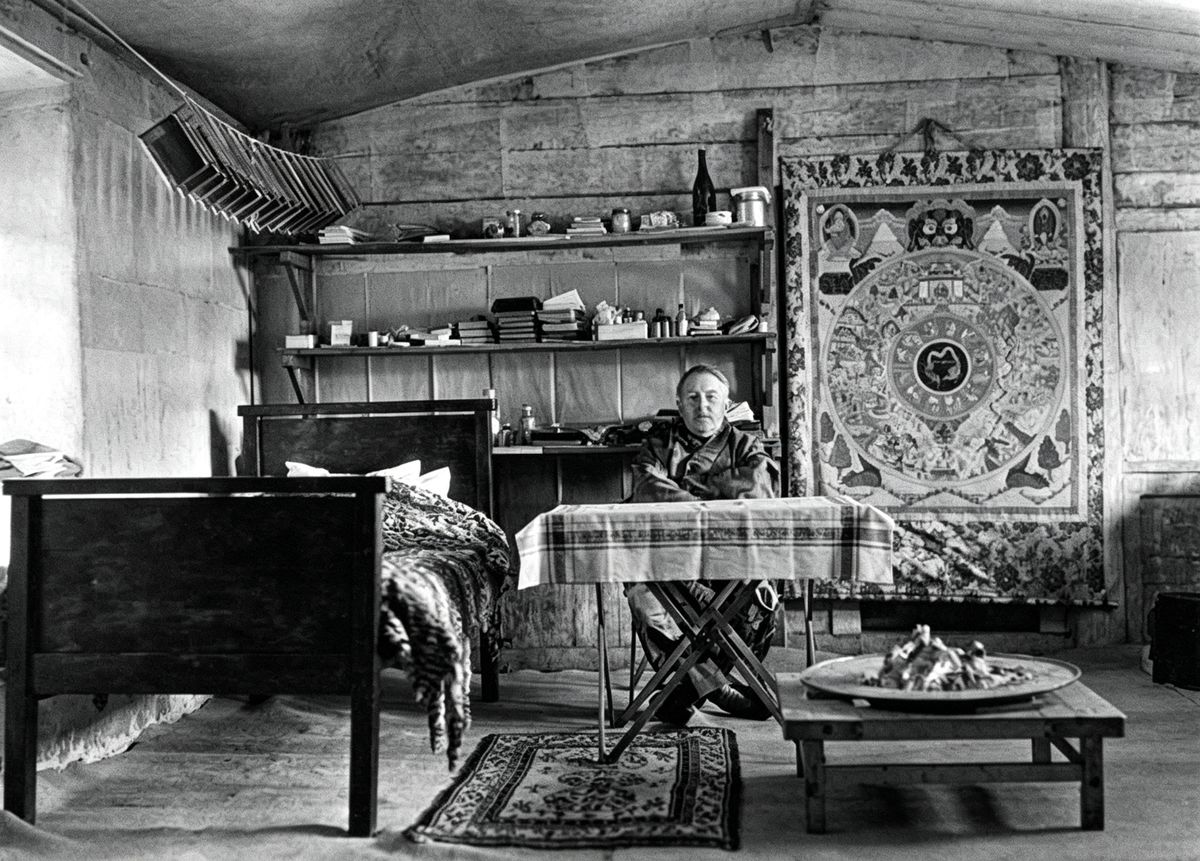
*▲ Rock in his room in Yuhu Village, Lijiang, 1927-1929. © National Geographic Society*
Many people know Lugu Lake because of the Mosuo (摩梭) Walking Marriage; many know Lijiang because of Shangri-La in James Hilton's Lost Horizon. Few people know that the same man first introduced both places to the Western world — Joseph Rock (约瑟夫·洛克).
He was not a missionary, not a diplomat, not a professional explorer. He was a self-taught botanist, an Austrian immigrant who spoke six languages, a "foreigner" who lived for 27 years at the foot of Jade Dragon Snow Mountain. He took more than ten thousand photographs, wrote ten books, collected several thousand plant specimens, and finally died in a small apartment in Hawaii surrounded by the unfinished manuscript of a Naxi dictionary.
From Vienna to Honolulu: A "Professor" Who Never Went to University
Rock was born in 1884 in Vienna, Austria, into a servant's household. His father wanted him to be a cook, but from boyhood he was fascinated by languages and faraway places. At 13 he renamed himself "Joseph Francis Rock" because he thought it sounded like an explorer's name.
At 18 Rock left Europe and travelled across North Africa and the continent. In 1905 he reached the United States and eventually settled in Hawaii. At Mills College in Honolulu he became a teacher of Latin and natural history — even though he himself had never graduated from university. (Note: the exact name and status of this Honolulu school — Mills College vs Mills Institute — is uncertain across sources; marked as unverified.)
During his 13 years in Hawaii Rock learned plant taxonomy, published dozens of papers on Hawaiian flora, and became a well-known local botanist. He also taught himself Chinese — an Austrian who had never been to university, mastering German, Italian, Greek, Chinese and English through self-study.
In 1920 the U.S. Department of Agriculture gave him an assignment: to travel to Southeast Asia in search of a tree called chaulmoogra, said to cure leprosy. Rock took the job and headed north from Bangkok, through Myanmar and Yunnan, until he reached Lijiang.
He had intended to stay only a few months. He stayed 27 years.
"Wuluke" Beneath Jade Dragon Snow Mountain
Rock first arrived in Lijiang in May 1922. At the foot of Jade Dragon Snow Mountain he found a Naxi village called Yuhu, known in Naxi as "Wuluke" — "the village at the foot of the snow mountain."
He took to the place at once. Stone-built houses, the snow mountain behind, Jade Lake in front, the Lijiang plain in the distance. He rented a courtyard in the village, made it his home, and turned it into the headquarters for all his expeditions across China.
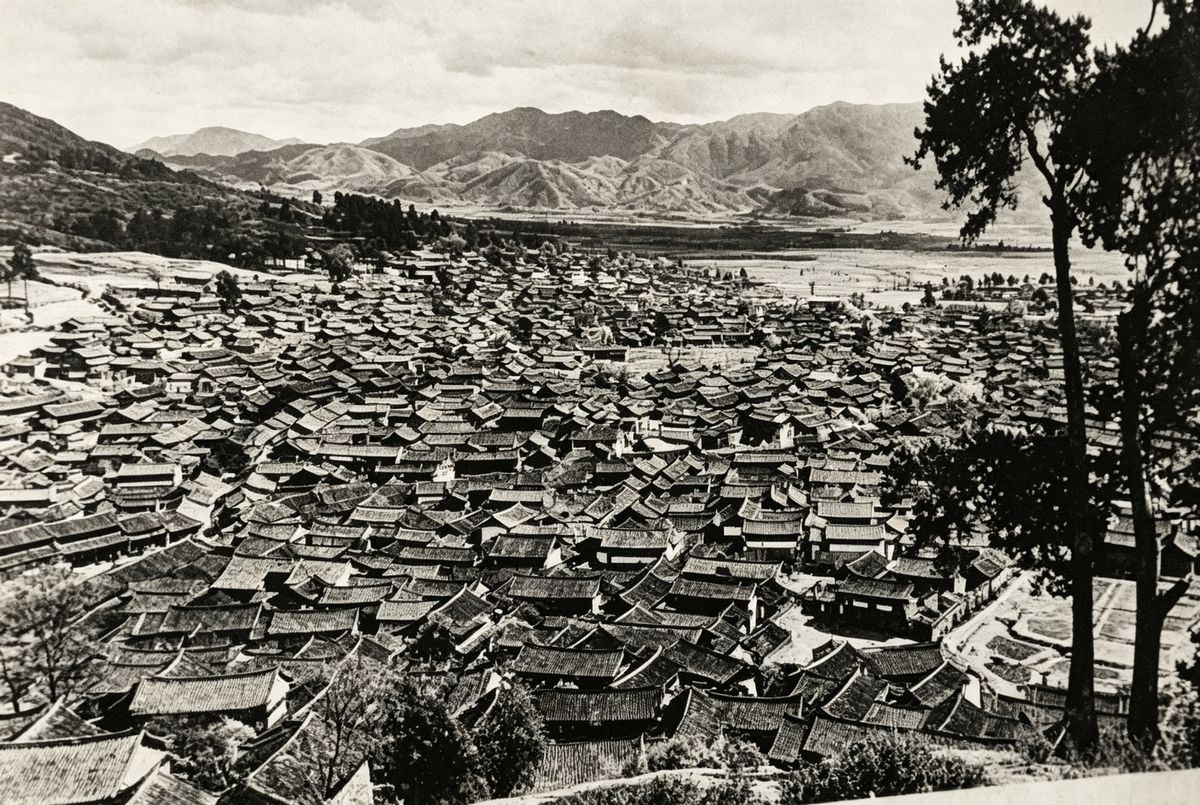
*▲ Panoramic view of the Old Town of Lijiang, looking southeast from the direction of Jade Dragon Snow Mountain. Photographed by Rock*
Rock lived an extravagant life in Yuhu Village. He employed more than twenty Naxi attendants — grooms, guides, cooks, interpreters. Every expedition set out with a caravan of dozens of men, carrying tents, plant presses, cameras and a typewriter.
He wrote articles and took photographs for National Geographic (国家地理); the fee for a single piece kept him in Lijiang for more than half a year. The U.S. Department of Agriculture and the Harvard Botanical Institute funded him to collect plant specimens. His teams covered northwest Yunnan, southwest Sichuan, Qinghai and Gansu, gathering several thousand plant specimens, among them more than a hundred species new to science.
But what truly obsessed Rock was not plants.
Dongba Script: An Accidentally Discovered "Living Fossil"
In Lijiang Rock met for the first time the priests of Dongba religion — the Dongba. These Naxi "shamans" held in their hands a strange kind of scripture written in dense pictographs.
The script was extraordinary. It is the only pictographic writing still in use anywhere in the world — more primitive than oracle-bone script, yet the Naxi kept using it well into the 20th century.
Rock was captivated at once. He hired several Dongba to teach him to read the scriptures and explain the rituals. He began collecting Dongba scriptures, buying them one by one, and eventually amassed several thousand volumes. Most of these are now held by Harvard University and the Library of Congress, and became the most precious Western source for the study of Naxi culture.
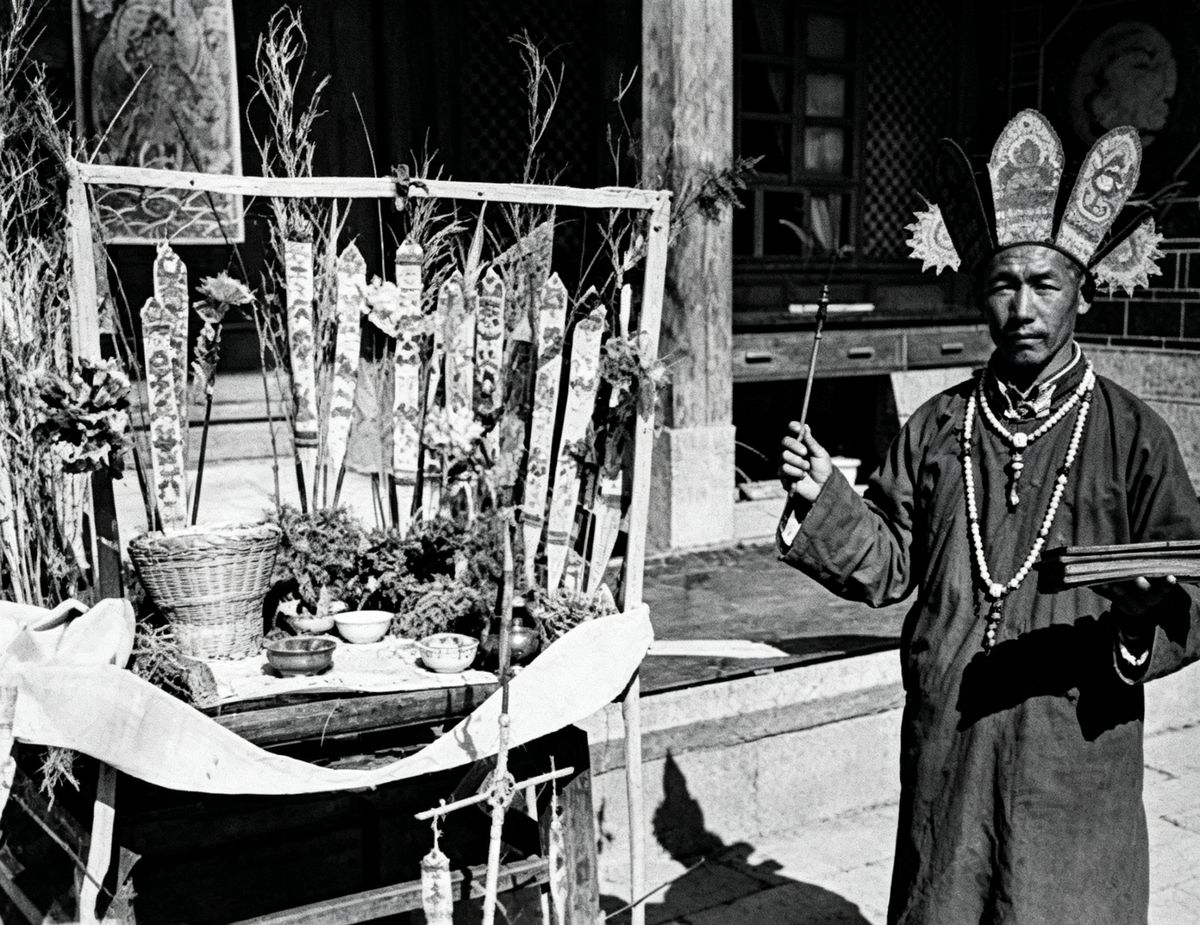
*▲ 1925: a Naxi Dongba priest and his altar, photographed by Rock. © National Geographic Society*
From the 1930s onward Rock more or less abandoned botany and devoted himself entirely to Naxi studies. He spent a full ten years (1935-1945) compiling a Naxi-English encyclopedic dictionary of more than two thousand pages. He also wrote The Ancient Naxi Kingdom of Southwest China, a detailed record of Naxi history, geography, religion and customs.
Later scholars called him "the father of Naxi studies." Rock himself disagreed. "I am not a scholar," he said. "I am just a botanist who became fascinated by the Naxi."
Lugu Lake: A Place Fit for the Immortals
During his 27 years in Lijiang, Rock never confined himself to Lijiang. He travelled the entire Hengduan mountain region, and of all those places he loved Lugu Lake most.
Rock first came to Lugu Lake in 1924. Invited by A Yunshan, the head administrator of Yongning (永宁), he stayed on Xieva E Island in the middle of the lake. At that time the island held a villa built by A Yunshan — carved beams and painted rafters, a blend of Han and Tibetan styles, the grandest place on all of Lugu Lake.
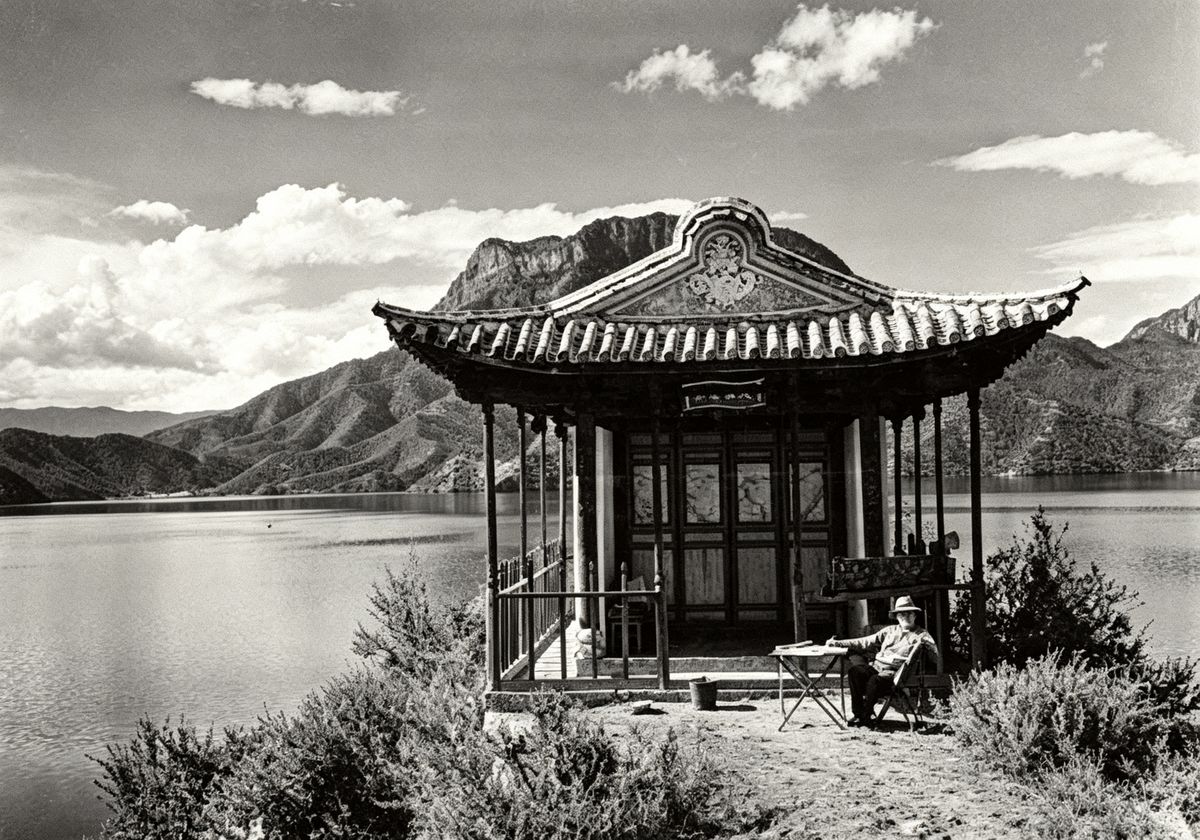
*▲ 1929: Rock in the pavilion on Xieva E Island, Lugu Lake. © National Geographic Society*
Rock lived on the island for many years. At its far end he built a pavilion and sat there every day looking out over the lake. He wrote: "This is a place fit for the immortals. The water is crystal clear, and in the distance Goddess Gemu (格姆女神山) lies quietly beside the shore, like a goddess fast asleep."
He and A Yunshan became the closest of friends. A Yunshan was the head administrator of the Yongning Mosuo — the highest local chief. Every time Rock came to Lugu Lake he stayed in A Yunshan's villa. A Yunshan gave him protection, served as his guide, and introduced him to Mosuo culture. In return Rock photographed A Yunshan's family and brought them gifts from the outside world.
Rock came to Lugu Lake for the last time in 1942. By then A Yunshan had died. On the wall of the island pavilion Rock wrote in English: "If this is the last time I see Lugu Lake, it grieves me deeply to say so. Lugu Lake is still beautiful, but without my old friend A Yunshan I cannot bear to live here."
After writing those words he left Lugu Lake and never returned.
Lost Horizon: Rock's "By-Product"
Rock published a great many articles and photographs on the Hengduan region in National Geographic. The most famous describes his 1928 expedition crossing from Muli to Yading.
In June 1928 Rock set out from Muli with 21 Naxi attendants, trekking across the Gongga range and reaching Yading. He was the first Westerner to arrive there. He saw the three sacred mountains — Chenrezig, Jambeyang and Chanadorje — took countless photographs, and published them in National Geographic.
Those photographs and articles were seen by the British writer James Hilton. In 1933 Hilton wrote a novel called Lost Horizon, which described a place called "Shangri-La" — snow mountains, monasteries, an earthly paradise, eternal youth.
The book was an instant sensation. "Shangri-La" became a byword for an earthly paradise. Later, Zhongdian County in Yunnan simply renamed itself "Shangri-La City."
Many call Rock the "discoverer" of Shangri-La. But Rock himself never claimed as much. He was only a botanist, an explorer, a foreigner enchanted by Naxi culture. It never occurred to him to create a "tourism IP."
The Final Years
In 1949, after the founding of New China, Rock left China. He went first to Myanmar and finally back to Hawaii.
In his last years in Hawaii Rock kept revising his Naxi-English encyclopedic dictionary. He wanted to publish it, but funding never materialised. He lived on writing articles and selling specimens, in great poverty.
On 5 December 1962 Rock died in Hawaii at the age of 78. When he died he was surrounded by the unfinished manuscript of his dictionary and thousands of unsorted photographs.
He never married. "I married Naxi culture," he said. "She is my only wife."
Rock Today
Today, if you go to Yuhu Village in Lijiang, you can still see Rock's former residence — a stone courtyard holding the typewriter, surveying instruments and old photographs he once used. The ticket costs 25 yuan, and there are not many visitors.
If you go to Xieva E Island on Lugu Lake, you can still see the ruins of the villa where Rock stayed — it was torn down during the Cultural Revolution, leaving only broken walls. On the island still stands a eucalyptus tree that Rock planted with his own hands, now grown into a towering tree and classed as a protected first-grade plant of Lugu Lake.
If you go to Yading in Daocheng, you can still see "Rock's Hut," a memorial to the route he once crossed. Every year tens of thousands of trekkers walk "the Rock Line," hiking from Muli to Yading along the very road he took in 1928.
Rock was no saint. He was a Westerner of his time, carrying the superiority of the colonial era and the utilitarian spirit of the explorer. Many of the specimens and scriptures he collected were "taken" from China and now rest in Harvard and the Library of Congress.
But he was also the first Westerner to truly respect Naxi culture and to genuinely want to introduce Mosuo culture to the world. The photographs he took and the words he wrote became, and remain, the most precious material we have today for studying Mosuo and Naxi culture.
Without Rock, Lugu Lake might have remained unknown to the outside world for decades longer. Without Rock, Lijiang might still be just an ordinary small county town in Yunnan. Without Rock there would be no Lost Horizon, and no Shangri-La as we know it today.
He is a man who has been misread. Some call him a spy, some a cultural robber, some a friend of the Naxi.
But he himself would probably say: I was just a botanist who loved snow mountains and lakes, and who happened to live in Lijiang for 27 years.
---
Related reading: