
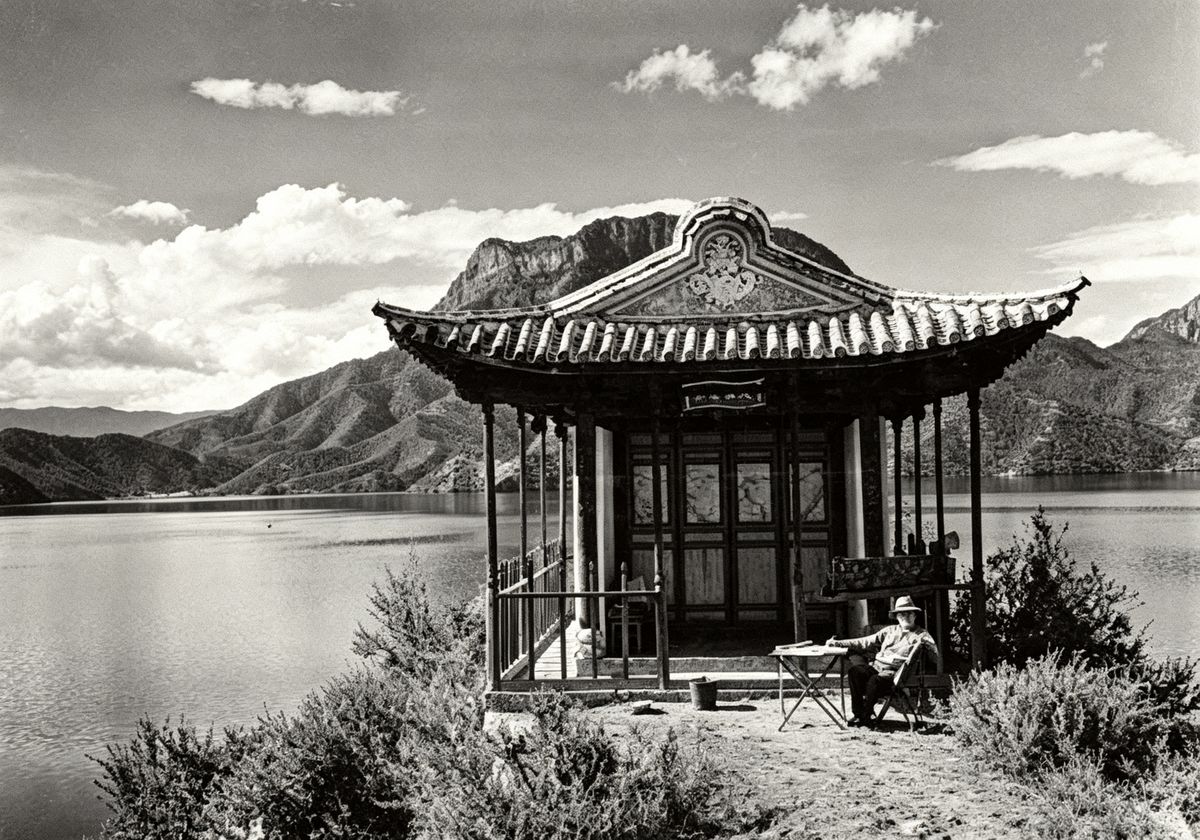
*▲ 1929: Joseph Rock in the pavilion on Xieva E Island at Lugu Lake. © National Geographic Society*
When Joseph Rock (约瑟夫·洛克) first came to Lugu Lake in 1924, there was no road, no tourists, no guesthouses. To go from Lijiang to Lugu Lake took a week along a horse-caravan trail.
He had been invited by A Yunshan (阿云山), the chief administrator (zongguan) of Yongning. A Yunshan had heard that a foreign scholar had arrived in Lijiang — he could take photographs, he could write, and he was interested in Mosuo (摩梭) culture — so he sent a message: come and see Lugu Lake, I will put you up on the island.
Rock came. And he stayed for eight years.
Xieva E Island: The Mosuo "Chieftain's Island"
Xieva E Island (谢瓦俄岛) lies in the middle of the north-western half of Lugu Lake, about two kilometres from the shore. It is not large: less than 300 metres from east to west, and a hundred-plus metres from north to south.
The island has several names. Locals call it "Snake Island", because after summer rains many snakes come out to bask in the sun. Because A Yunshan built a villa on it, it is also called "Chieftain's Island". And because Rock once lived here, some now call it "Rock Island".
A Yunshan was the 23rd-generation chief administrator of the Yongning Mosuo. He was not a tusi (chieftain) — Yongning had no tusi, only chief administrators — but in real power he was much the same, ruling the whole Yongning plain and the Mosuo around Lugu Lake.
In 1935, A Yunshan built a villa on the island. The house followed the traditional Mosuo log-house structure, but its fittings blended Han and Tibetan styles — carved and painted beams, glass windows, carpets on the floor. At Lugu Lake in those days it was the most lavish building of all.
A Yunshan built the villa for three reasons: first, to escape the summer heat; second, to evade bandits — the island sits in the middle of the lake, and bandits could not reach it; and third, to receive far-travelled guests such as Rock.
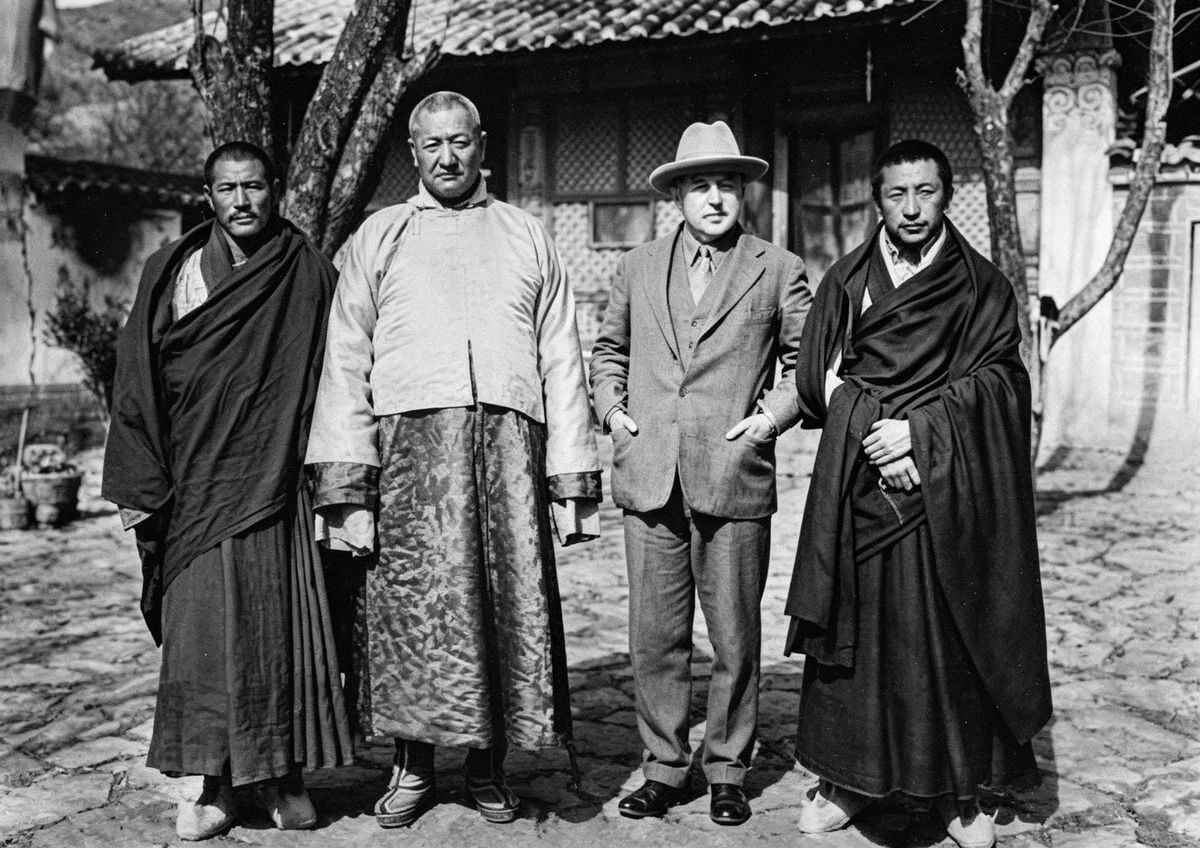
*▲ Rock with A Yunshan and other Yongning aristocrats. © National Geographic Society*
The villa was not yet built when Rock first came to the island, but he fell for the place at first sight. He wrote in his diary: "At the very top of the island there is an exquisite rest-house, like a teahouse. Standing there, you can see the whole of Lugu Lake, and in the distance Mount Gemu (格姆女神山) lies quietly beside the water. Everything here is beautiful and full of artistic feeling."
From 1924 to 1932, Rock came to Lugu Lake almost every year, and each time he stayed on Xieva E Island. At the tail of the island he built himself a small pavilion, where he sat every day looking out at the lake, writing and taking photographs.
Rock and A Yunshan: A Friendship Between Two Men
The friendship between Rock and A Yunshan is the most famous cross-border friendship in the history of Lugu Lake.
A Yunshan was a few years older than Rock. He was the Mosuo chief administrator, a man who had seen the world and spoke a little Chinese. Rock was a foreign scholar who spoke a little Naxi and was full of curiosity about Mosuo culture.
The two men did not share a language, but that did not stop them from becoming friends. Rock photographed A Yunshan and brought him gifts from the outside world — glass, mirrors, Western medicine, foreign wine. A Yunshan gave Rock protection, acted as his guide, and introduced him to Mosuo culture and customs.
Every time Rock came to Lugu Lake he brought a horse-caravan train with him. A Yunshan would arrange people to meet him, prepare a pig-trough boat (猪槽船), and have the island villa ready. All of Rock's food, drink and daily needs on the island were taken care of by A Yunshan.
Rock took many photographs of A Yunshan's family — of A Yunshan himself, his household, and his subjects. These photographs were later published in National Geographic magazine, and today they are the most precious material we have for studying Mosuo history.
Of A Yunshan, Rock wrote: "He is a cultured gentleman, a true aristocrat. The warmth with which he received me exceeded anything I imagined. Every day I spent at Lugu Lake was given to me by him."
A Yunshan was also fond of Rock. He told others: "This foreigner has not come to take things, he has come to learn things. He is a friend of us Mosuo."
Days on the Island
Rock's days on Xieva E Island were those of a gentleman in seclusion.
Each morning he rose and first watched the sunrise from the pavilion — the sun rising behind Mount Gemu and gilding the lake. Then breakfast, writing, and sorting specimens. In the afternoon he went out to survey — rowing to the shore, riding horseback to the Yongning plain, to the grassy sea (草海), to the Walking Marriage Bridge (走婚桥). In the evening he returned to dine in the villa and talk with A Yunshan.
Rock planted many trees on the island. One eucalyptus he planted with his own hands in the early 1920s; today it has grown into a towering tree and is a first-class protected plant at Lugu Lake.
He also built a temporary work station on the island — a small stone house for his specimens, camera and typewriter. The stone foundations of that station still stand, beside the villa ruins.
During his eight years at Lugu Lake, Rock did a great deal:
- He took hundreds of photographs of Lugu Lake — lake views, island scenes, Mosuo people, buildings, ceremonies
- He collected many Mosuo artefacts — scriptures, costumes, utensils
- He recorded the Mosuo Walking Marriage (走婚) customs, the matrilineal family structure, and the religious rituals
- He wrote many articles about Lugu Lake, published in National Geographic
These materials became the world's first-hand source for understanding Mosuo culture today.
1942: The Last Departure
In 1942, Rock came to Lugu Lake for the last time.
By then A Yunshan had died. His son had inherited the position of chief administrator, but he was not close to Rock.
Rock went alone onto Xieva E Island. The villa was still there, but it no longer had its old bustle. He sat in that old pavilion, looking out at Lugu Lake, and sat there for a whole day.
Before leaving, he wrote an inscription in English on the left wall of the pavilion:
> "If this is the last time I see Lugu Lake, my heart is truly heavy as I say it. Yet, at my age, how else could I speak? Lugu Lake remains as beautiful as ever, but now that my old friend A Yunshan is gone, I cannot bring myself to stay here any longer. I must bid you farewell, with lingering regret."
After writing these words, Rock rowed away from Xieva E Island. He never came back.
Destruction in the Cultural Revolution
In 1966 the Cultural Revolution began. The villa on Xieva E Island was torn down as "old ideas, old culture". The carved and painted beams were smashed, the glass shattered, the furniture burned.
Today only broken walls and rubble remain on the island — a few stone walls, a stretch of foundations, and that eucalyptus Rock planted in his day.
Later, in the 2000s, when tourism was developed, a small pavilion was rebuilt on the island as a memorial to Rock. But compared with the villa A Yunshan once built, it falls far short.
Today, when you go to Lugu Lake and take a pig-trough boat out to Xieva E Island, you can still see the villa ruins — a few low walls overgrown with weeds. A sign stands on the island reading "Former Residence of Joseph Rock".
Standing on the island, looking at Mount Gemu in the distance and at the crystal-clear water, you can probably understand why Rock once called it "a place fit for the immortals to dwell in".
What Rock Left Behind
What did Rock's eight years at Lugu Lake leave to this place?
First, photographs. The hundreds of old photographs of Lugu Lake taken by Rock are the earliest images of Lugu Lake that we can see today. In them are the Mosuo people of that time, the buildings of that time, the lake and mountain scenery of that time. Without these photographs, we would have no idea at all what Lugu Lake looked like 90 years ago.
Second, words. The articles Rock published in National Geographic about Lugu Lake were the first window through which the Western world came to know Mosuo culture. Many foreigners who know Lugu Lake today came to know it through Rock's writing.
Third, friendship. The friendship between Rock and A Yunshan was the first truly equal friendship between the Mosuo people and the Western world. In that era, Westerners who came to China came either to preach, or to plunder, or to trade. Rock was the first Westerner who truly respected the Mosuo and truly treated them as friends.
Of course, Rock was no perfect figure. Many of the Mosuo artefacts he collected are now held by Harvard University and museums in the United States; the copyright of those photographs also rests with the U.S. National Geographic Society.
But in any case, without Rock, Lugu Lake might have taken several more decades to become known to the outside world. Without Rock, Mosuo culture might long since have vanished into history.
He is a man who has often been misread. But he is also the most important foreigner in the history of Lugu Lake.
---
Related reading: