
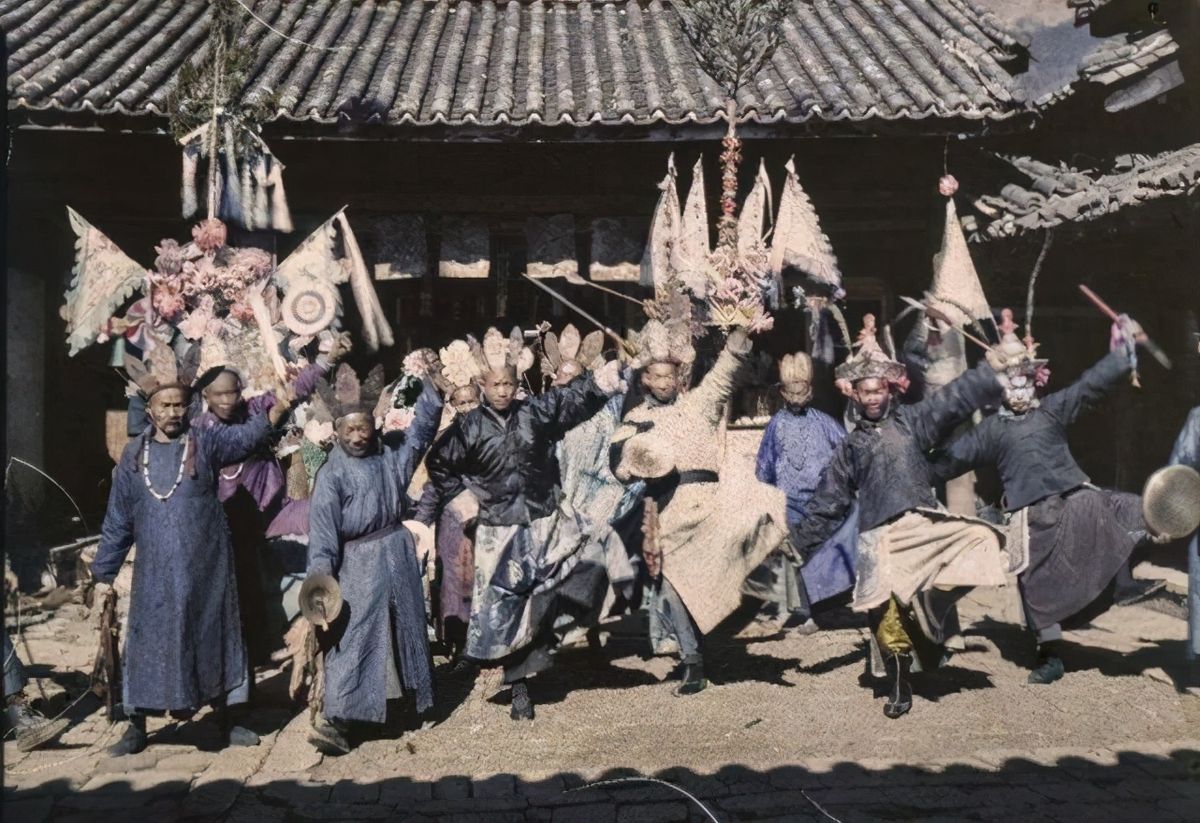
*▲ Dongba wind-worshipping ritual, colour photograph, 1930. © National Geographic Society*
Today, searching "Lugu Lake" on Baidu returns millions of results. But a hundred years ago, the Western world had no idea where Lugu Lake was.
The first person to introduce Lugu Lake to the Western world was not a missionary, not a diplomat — it was a botanist who wrote for National Geographic magazine: Joseph Rock (约瑟夫·洛克).
From 1922 to 1949, Rock published dozens of articles in National Geographic and took thousands of photographs. These articles and photographs were the first to let the Western world know of Lijiang, Lugu Lake, the Naxi people, and the Mosuo.
National Geographic's "China Correspondent"
In the 1920s, the U.S. magazine National Geographic was the most famous geographical magazine in the world. Its readers spanned Europe and America, and each issue ran to hundreds of thousands of copies.
Rock was a special correspondent for National Geographic. The articles and photographs he sent back from southwest China were among the magazine's most popular content.
Rock wrote well. He was no dry academic writer; he told stories, recounting the scenery he saw, the people he met, the things he lived through. His photographs were good too — colour photography had just been invented, and Rock was one of the first photographers to use colour film in southwest China.
From 1923 to 1949, Rock published about 40 articles in National Geographic. Among the best known:
- "The Naxi: A Matrilineal People on the Tibetan Border"
- "In the Mysterious Kingdoms of Southwest China"
- "Konkaling: In the Heart of the Sacred Mountains"
- "Lugu Lake: The Place Where the Immortals Dwell"
Each of these articles came with dozens of photographs. Opening the magazine, readers felt as if they were walking with Rock into that distant, mysterious southwest China.
Dongba Script: What Fascinated Rock Most
Most of the articles Rock published in National Geographic were not about scenery. What fascinated him most was the Dongba culture of the Naxi people.
Dongba script is the only pictographic writing still in use in the world. It is even more primitive than oracle-bone script, and works like drawing — a circle stands for a person, three circles for three people, a mountain-shaped character for a mountain.
Rock first saw Dongba script in a Dongba priest's home in Lijiang. He saw the priest holding a scripture painted all over with strange symbols. He asked: what is this? The priest said: this is our writing, which records our history and our rituals.
Rock was hooked at once. He began collecting Dongba scriptures, buying them one by one. He hired several Dongba priests to teach him to read the texts and explain the meaning of every symbol.
From the 1930s onwards, Rock spent almost all his time on Dongba script. Over 10 years he compiled a Naxi–English Encyclopedic Dictionary, more than 2,000 pages thick. To this day it remains the most authoritative work for the study of Naxi culture.
The Dongba scriptures Rock collected number several thousand volumes. Most of them later went to the Harvard-Yenching Library, becoming the West's most precious material for Naxi studies.
Rock's Photographs: The Earliest Colour Images of Southwest China
Rock was not only a writer but also a photographer. Carrying the most advanced cameras of the day, he travelled through northwest Yunnan and southwest Sichuan and took tens of thousands of photographs.
Many of these are "the earliest colour photographs of southwest China". Colour film had just been invented and was expensive; ordinary photographers could not bring themselves to use it. But Rock had money — National Geographic covered his expenses, and he could shoot as much as he liked.
The subjects of Rock's photographs were rich and varied:
- Landscape: Jade Dragon Snow Mountain, Lugu Lake, Daocheng Yading, Muli
- People: the Naxi, the Mosuo (摩梭), Tibetans, the Yi
- Architecture: Lijiang Old Town, lama temples, Mosuo log houses (木楞房)
- Rituals: Dongba ceremonies, Mosuo funerals, Tibetan Buddhist dharma gatherings
These photographs are now kept in the archives of the U.S. National Geographic Society. In 2024, the Xie Zilong Photography Museum in Changsha held an exhibition called "Between Naxi and Tibet: Joseph Rock's Ethnographic Photography in China", showing many of Rock's photographs — many of them in public for the first time.
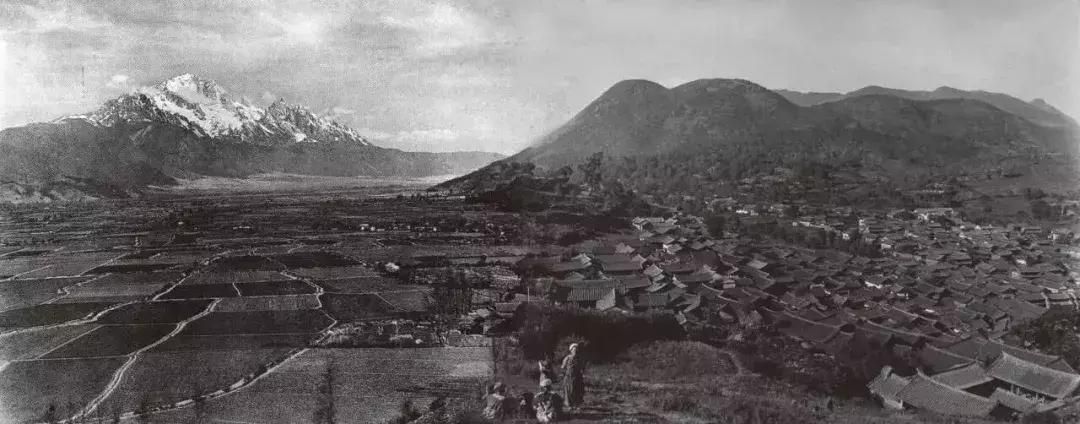
*▲ The Lijiang plain and Jade Dragon Snow Mountain. © National Geographic Society*
What Rock Brought to the Western World
What did those articles and photographs Rock published in National Geographic bring to the Western world?
First, the idea of "Shangri-La". The snow mountains, lama temples and Tibetan scenery Rock photographed made Western readers feel: there is an earthly paradise in southwest China, where the scenery is exquisite, the people are simple, and time seems to have stopped. This imagination directly gave birth to Hilton's Lost Horizon.
Second, an awareness of Naxi culture. Before Rock, the Western world knew nothing of the Naxi. Rock's articles and photographs let Westerners know for the first time: in southwest China there is a people with a strange pictographic script and a distinctive Dongba religion.
Third, an awareness of the Mosuo of Lugu Lake. Rock was the first person to introduce the Mosuo to the Western world. In his articles he wrote of the Mosuo Walking Marriage (走婚) system, the matrilineal family (母系家庭), and the scenery of Lugu Lake. Western readers learned for the first time: in China there is a place where women are the masters of the home, where men do not marry, and where children take their mother's surname.
This vision of a "matrilineal society" deeply fascinated Western readers. Many Westerners learned of Lugu Lake and came to want to see this "Kingdom of Women" (女儿国) precisely because they had read Rock's articles.
Rock's Legacy: A Great Deal of Dispute
Rock's contributions were great, but so was the controversy around him.
Some called him a "cultural robber". The several thousand Dongba scriptures he collected now sit in American libraries; the copyright of those photographs rests with the U.S. National Geographic Society. Many Chinese feel: these things were always China's, and he "took" them to America.
Some called him a "spy". When Rock explored southwest China it was an era of war and chaos. The places he travelled — Muli, Daocheng, Ganzi — were all military strongpoints. Some suspected he was a spy sent by the U.S. government to gather intelligence.
Others called him a "friend of the Naxi". He truly loved Naxi culture and truly respected the Naxi people. He spent his whole life studying Naxi culture and introduced it to the world. Without him, Naxi culture might have long since vanished.
These disputes are still not settled today.
Why We Still Read Rock Today
Today, wherever you go — to Lijiang, to Lugu Lake, to Daocheng Yading — you see Rock's name everywhere: Rock's former residence, the Rock Trek, Rock Island, Rock's cabin.
Why? Because Rock was the first to discover these places. He was the first to introduce them to the world through his lens and his words.
When we read Rock's articles and look at his photographs today, it is not for nostalgia. It is to know: what Lugu Lake looked like a hundred years ago, what the Mosuo were like a hundred years ago, what Lijiang was like a hundred years ago.
Those photographs and words are witnesses to history. They record a world that was disappearing — a matrilineal society, Dongba culture, horse-caravan trails, log houses.
Many of those things are gone now. But Rock's photographs remain. Through his lens we can still see that vanished world.
That is probably the most precious legacy Rock left us.
---
Related reading: